


Finance
You Prepare a Hotel P&L. But Do You Use It to Manage Profit?

Why Strong General Managers Continue to Study International Management Reporting Standards
Most hotel general managers work with a P&L (Profit & Loss) statement every day. They know the key indicators, control expenses, participate in budgeting and regularly present results to owners.
This raises a reasonable question: if the report is prepared every month, why does hotel profit not always grow?
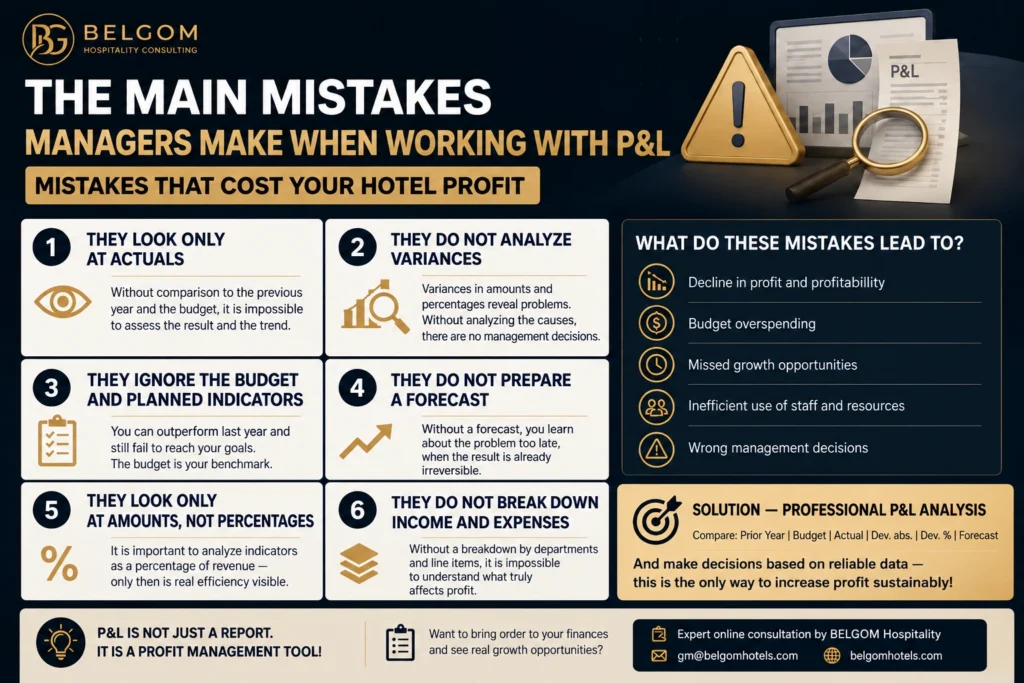
The answer is simple. A P&L statement does not increase profit by itself. Profit grows when a manager can analyse the data correctly, identify variances and act before a problem affects the financial result.
This is why experienced general managers, operators and hotel owners continually improve their knowledge of international management reporting standards.
Why Are Statutory Accounts Not Enough?
Many people assume that if all the data is in the accounting system, the management report is already complete.
In practice, this is one of the most common misconceptions.
Statutory accounting is designed to meet legal requirements.
An international P&L (Profit & Loss) statement is designed to manage a hotel.
Its purpose is to show not only the company’s financial result, but also the performance of each department, the revenue and cost structure, business profitability and opportunities for profit growth.
At the same time, a professional P&L is always based exclusively on actual accounting data.
As a rule, data from 1C are used, based on actual ledger accounts (10, 20, 23, 25, 26, 41, 44, 60, 69, 70 and others). The figures are then allocated among the hotel’s departments according to management-accounting methodology.
This is why an international P&L cannot be generated with a single click.
What Does an International Hotel P&L Show?
Unlike a standard income statement, an international P&L follows the operating logic of the hotel business.
It analyses not only absolute amounts but also percentage indicators, allowing the hotel’s performance to be assessed objectively regardless of season.
The structure typically includes several core sections.
Operating Indicators
Every analysis begins with an assessment of room-inventory performance.
The following are reviewed:
- Occupancy;
- Average Daily Rate (ADR);
- Revenue per Available Room (RevPAR);
- number of rooms sold;
- number of guests;
- double-occupancy factor.
These indicators show how effectively the hotel uses its principal asset: its room inventory.
Hotel Revenue
The next stage is to analyse revenue by profit centre.
The following are reviewed separately:
- Rooms;
- Food & Beverage (F&B);
- Conference & Banqueting (C&B);
- other operated departments;
- rental income;
- other operating revenue.
This approach reveals which areas genuinely generate profit and which require change.
Departmental Expenses
Understanding the cost structure is equally important.
The analysis covers:
- Rooms expenses;
- Food & Beverage expenses;
- expenses of other operated departments;
- Food Cost;
- Beverage Cost;
- Prime Cost;
- the operating expenses of each department.
Practice shows that even a modest reduction in cost of sales can substantially increase a hotel’s annual profit.
People: The Largest Cost Item
For most hotels, labour is the largest cost item.
Yet managers often look only at the total payroll figure.
Professional analysis goes much deeper.
It assesses:
- payroll;
- payments under civil-law contracts;
- outsourcing costs;
- total Labor Cost;
- staff costs as a percentage of revenue;
- average headcount;
- employees per room;
- the efficiency of work schedules.
This is often where hidden opportunities to improve profitability without reducing service quality are found.
Undistributed Expenses
Once the departments have been analysed, the hotel’s undistributed operating expenses are reviewed.
These include:
- Administration;
- Sales & Marketing;
- IT;
- Engineering;
- Utilities;
- general operating expenses.
Correct allocation makes it possible to assess each department’s performance objectively.
Financial Result
The P&L concludes with the calculation of key financial indicators:
- departmental profit;
- GOP (Gross Operating Profit);
- OIBDA;
- EBITDA;
- profit before tax;
- net profit.
These are the indicators that matter to owners, investors, banks and international hotel operators.
Why Is Prior Year Analysis Important?
Profit growth means little on its own.
It is necessary to understand:
- how much Occupancy increased;
- whether ADR changed;
- whether RevPAR increased;
- whether expenses grew faster than revenue;
- how the Labor Cost ratio changed;
- which departments performed better or worse than last year.
Only then can the hotel’s true development trends be seen.
Budget Reflects the Quality of Management
Even when performance exceeds last year, a hotel may still fail to meet its own plans.
A professional manager therefore always compares actual results with the budget.
This makes it possible to assess:
- achievement of financial targets;
- the effectiveness of the commercial strategy;
- the quality of cost management;
- achievement of key KPIs.
Why Is the Forecast More Important Than Last Month?
Most hotels analyse events that have already happened.
Strong general managers, however, use the P&L to manage the future.
This is why professional reporting always includes a Forecast.
The forecast makes it possible to determine in advance:
- whether the budget will be achieved;
- whether the hotel will reach its target profit;
- whether expenses need to be adjusted;
- whether sales efforts need to be intensified;
- whether the pricing strategy must change;
- how EBITDA and GOP will develop by the end of the period.
This enables decisions to be made before the financial outcome becomes irreversible.
Why Analyse Percentages as Well as Amounts?
Another mistake is to assess monetary values alone.
An international P&L requires each line item to be analysed:
- as an absolute amount;
- as a percentage of revenue;
- against budget;
- against prior year;
- against forecast.
For example, a 12% increase in revenue appears positive.
But if Labor Cost rises by 18%, Food Cost increases by 4% and EBITDA falls at the same time, performance cannot be considered effective.
Percentage indicators reveal the hotel’s true financial condition.
Why Do Strong General Managers Keep Learning?
Today’s general manager is responsible for more than service.
They manage profit, investment, expenses, departmental performance and the value of the hotel business.
The best managers therefore continually develop their knowledge of:
- international P&L (Profit & Loss) standards;
- management accounting;
- budgeting;
- hotel analytics;
- financial modelling;
- strategic management.
A deep understanding of P&L is what enables managers to move from simply monitoring figures to managing the hotel’s financial performance.
BELGOM Hospitality Expert Online Consultation
If you want to understand international P&L standards more clearly, learn to analyse management reports professionally and make decisions based on objective data, an individual consultation allows us to focus on your specific hotel project.
During the meeting, we can discuss:
✔ the international structure of a P&L (Profit & Loss);
✔ analysis of revenue, expenses and financial results;
✔ the methodology for preparing management reports from 1C data;
✔ interpretation of key performance indicators;
✔ budgeting and Forecasting;
✔ investment appraisal of a hotel project;
✔ hotel development strategy;
✔ operations management, sales and marketing;
✔ practical questions faced by a general manager.
After the consultation, you will receive:
- Excel templates for ongoing work;
- additional analytical materials;
- recommendations tailored to your hotel project;
- answers to your individual management questions.

ARTICLE AUTHOR
Alexander Belkin
Related Articles

Finance
Why a Profitable Hotel Can Lose Millions Every Year
High occupancy, stable revenue and positive cash flow do not necessarily mean that a hotel is operating at its full profit potential. Hospitality consulting practice shows that most owners assess business…

Finance
Restaurant Financial and Operational Analysis: Why a Full Dining Room Does Not Guarantee High Profit
A restaurant may enjoy high footfall, strong reviews and stable revenue. But if the owner does not know the true cost of each dish, control inventory or analyse operating expenses, profit starts to disappear…

Finance
Why High Room Revenue Still Fails to Deliver the Expected Profit
Most hotel owners and general managers monitor occupancy, ADR and RevPAR every day. Yet this is where one of the most common mistakes lies: revenue growth does not necessarily mean profit growth. A hotel can…